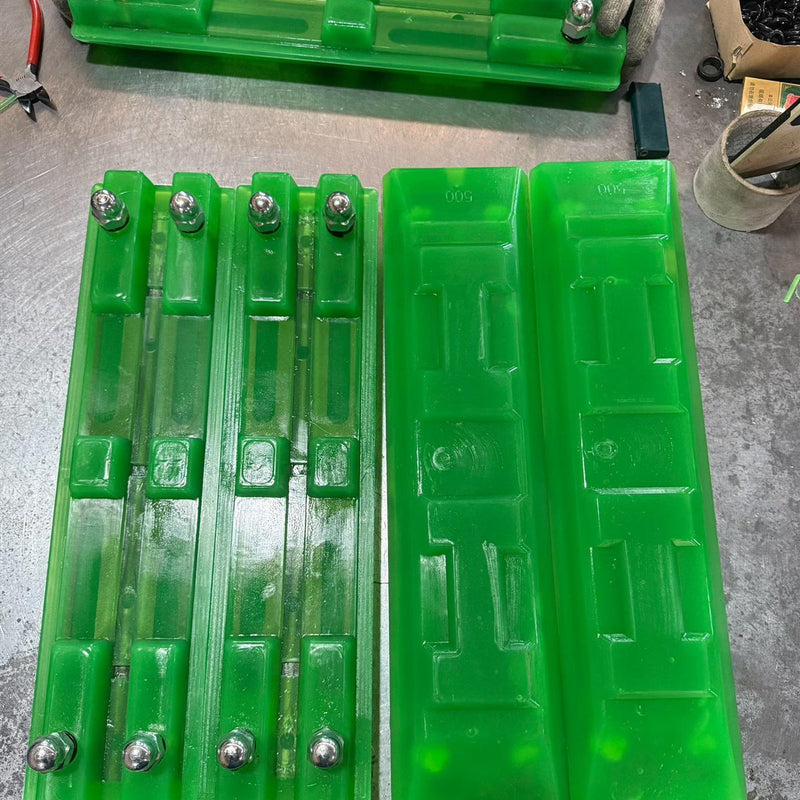
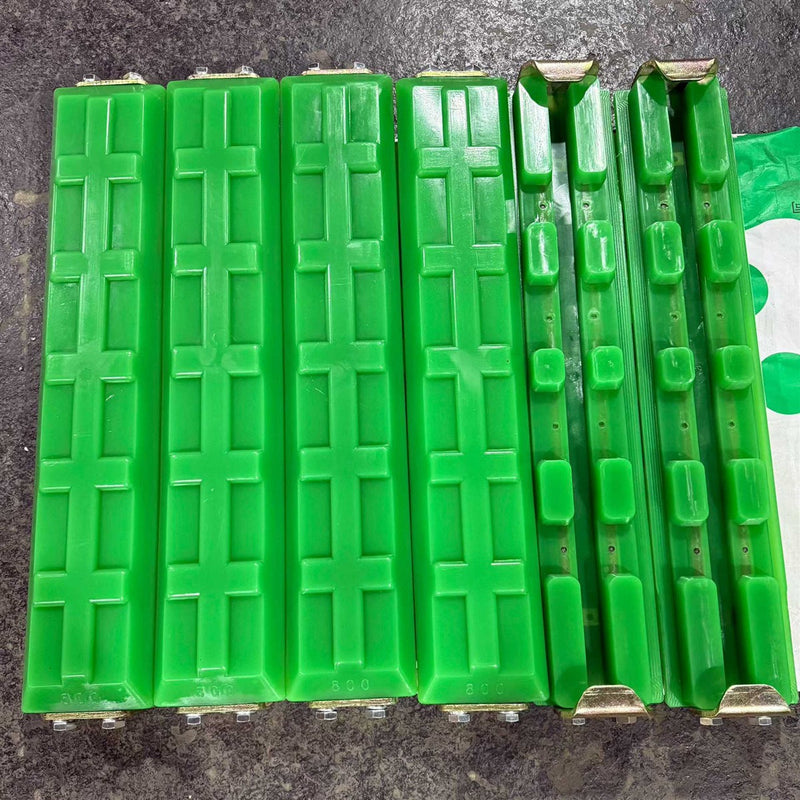
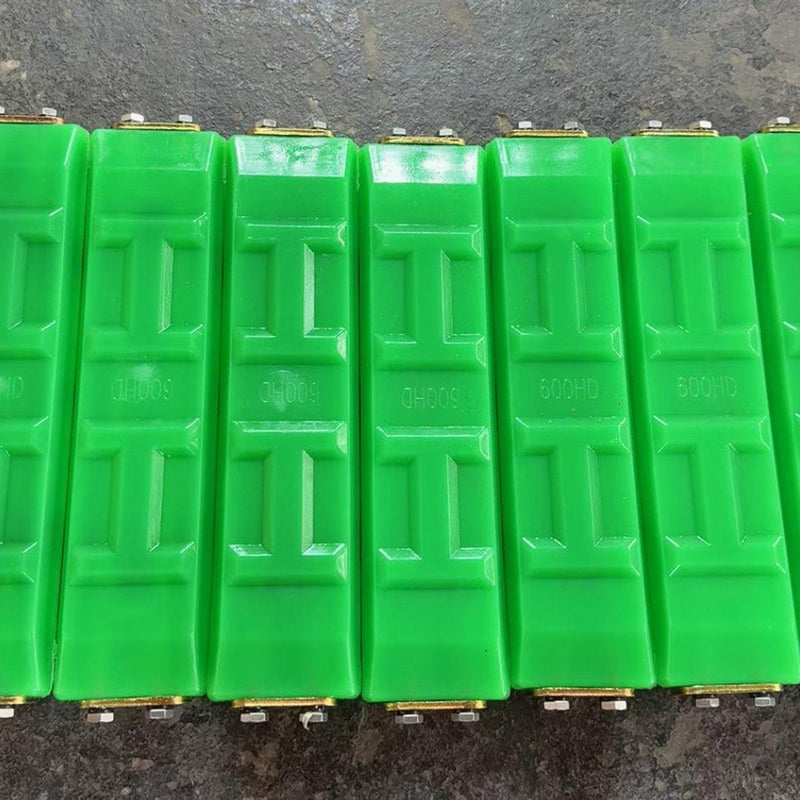
If you are deciding between bolt-on and clip-on excavator track pads, start by looking at the steel track shoes already fitted to your machine.
Both mounting styles do the same basic job: they place a polyurethane contact surface between the steel track and the ground. This helps reduce direct steel contact with asphalt, concrete, paving stones and other finished surfaces. The real difference is how the pad attaches and how the machine is used from one job to the next.
The short answer: choose bolt-on pads when the steel shoes have a compatible mounting-hole layout and the pads will stay on the machine for regular work. Choose clip-on pads when the shoe profile is compatible and a more removable arrangement is useful.
When bolt-on track pads make sense
Bolt-on pads are fixed through mounting holes in the steel track shoes. They are generally a practical choice for excavators that regularly work on paved or finished surfaces and will keep the pads installed for longer periods.
Consider bolt-on pads when:
- Your steel shoes have compatible pre-drilled mounting holes
- The pads will remain on the machine for regular use
- You prefer a firmly bolted installation
- The excavator frequently works on roads, concrete or paved jobsites
- Individual pad replacement is important to your maintenance plan

Before ordering, check more than the track width. The number of holes, distance between the holes and overall mounting layout must also match the pad. A 400mm bolt-on pad, for example, will not automatically fit every 400mm steel track shoe.
View the VectorMax bolt-on polyurethane track pad range.
When clip-on track pads make sense
Clip-on pads are held around the edges of the existing steel track shoe. They are useful when the shoes do not have suitable bolt-on holes or when the pads need to be fitted and removed more frequently.
Consider clip-on pads when:
- The machine moves between dirt and paved jobsites
- Faster installation and removal are important
- The steel shoes do not have compatible bolt-on holes
- The machine is part of a rental or mixed-use fleet
- Surface protection is only required for certain projects

Clip-on does not mean universal. The retaining hardware still needs to match the width, edge shape and grouser profile of the steel shoe. Worn, bent or heavily built-up shoes can also prevent the clips from sitting correctly.
View the VectorMax clip-on polyurethane track pad range.
The practical difference
| Selection point | Bolt-on pads | Clip-on pads |
|---|---|---|
| Attachment | Fixed through compatible holes in the steel shoe | Clamped around compatible shoe edges |
| Pre-drilled holes | Required for standard installation | Usually not required |
| Typical use | Regular or longer-term installation | Mixed work and more frequent changeovers |
| Main fitment check | Width, hole count, position and spacing | Width, edge shape, grouser profile and clearance |
A contractor who keeps one excavator on roadwork may prefer bolt-on pads. A rental fleet moving the same machine between landscaping, trenching and paved sites may find clip-on pads more convenient. Neither mounting style is automatically better in every situation.
Does one type last longer?
Mounting style alone does not determine service life. Pad wear is affected by machine weight, surface condition, travel speed, turning habits, installation quality and maintenance. Stones trapped between the pad and shoe can also cause uneven loading or damage.
Bolt-on pads are often selected for continuous use because they remain firmly installed. Clip-on pads are commonly selected for flexibility and faster changeovers. The better choice is the one that matches both the steel track shoe and the machine’s daily work.
Common selection mistakes
- Buying by width alone. Pads with the same nominal width can use different mounting arrangements.
- Relying only on the machine model. Used machines may have replacement shoes or a different undercarriage configuration.
- Ignoring worn or bent shoes. Damage can affect how securely a bolt or clip holds the pad.
- Choosing only by installation speed. The shoe must be compatible before convenience becomes relevant.
- Leaving debris on the mounting surface. Packed dirt and stones can prevent the pad from seating correctly.
A simple way to decide
Choose bolt-on pads if the machine has matching mounting holes and will spend most of its time on hard or finished surfaces.
Choose clip-on pads if the machine needs to move between different jobsite conditions or does not have suitable bolt-on holes.
If you are unsure, do not guess from a product photograph. Send us:
- Machine brand and model
- Steel track-shoe width
- Photos of the top and underside of one shoe
- Close-up photos of the mounting area
- Required quantity
VectorMax offers bolt-on and clip-on polyurethane track pads in widths from 230mm to 800mm. If you do not know which option to buy, our product specialists can help you compare the available choices.
For illustrated measuring examples, see the VectorMax track pad measuring guide or contact VectorMax for help.